16/05/2026


Blogs
Solar Radiation Sensor vs Pyranometer: Key Differences Explained
Solar Radiation Sensor vs Pyranometer: Key Differences Explained
Solar energy is growing extremely fast. Many countries and companies now depend on sunlight for electricity. But sunlight is not the same everywhere, and it changes throughout the day.
To use solar power properly, we must know one important thing: how much sunlight actually reaches the ground at a place.
Sunlight is very important because it helps with planning the size of a solar plant, checking if solar panels are performing properly, understanding weather patterns, calculating daily or monthly energy consumption, comparing different locations for solar projects, and predicting future power output.
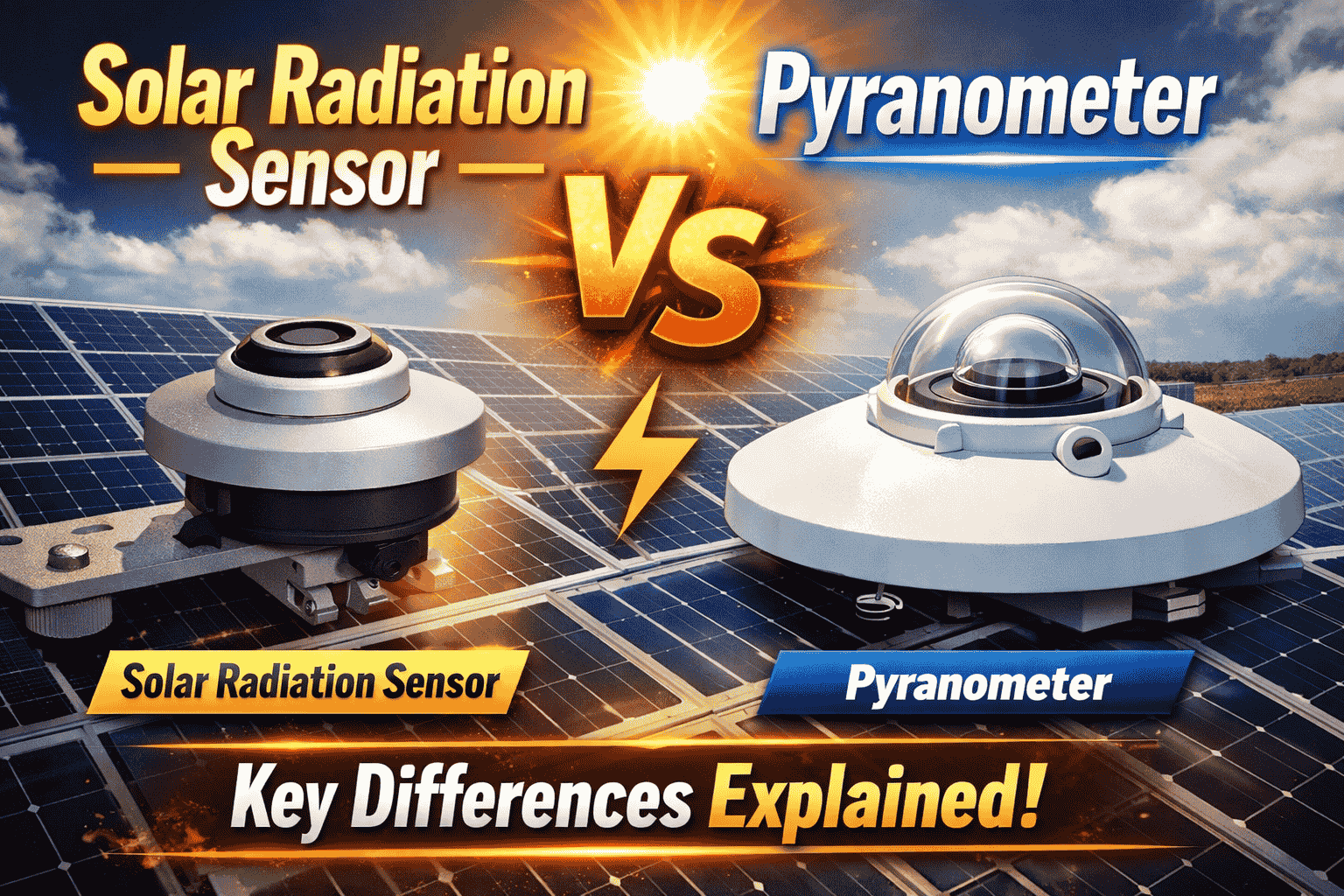
To measure sunlight, two types of devices are used mostly:
-
Pyranometer
-
Solar Radiation Sensor
People are usually confused between these two devices. They both measure sunlight, but they are not equal. Their working method, accuracy, price, and purpose are different.
What is a Pyranometer? The Standard for Solar Irradiance
A pyranometer is considered the main scientific instrument for measuring sunlight (solar irradiance).
It is designed to measure:
-
Direct sunlight.
-
Indirect light scattered from the sky.
-
Reflected light from surroundings
In short, it measures the total sunlight reaching the surface.
Pyranometers are used where accuracy is very high, such as:
-
National weather stations
-
Climate research centers
-
Universities
-
Laboratories
-
Large solar plants
-
Government solar testing centers
A key reason for its importance is that most pyranometers follow ISO 9060 standards. These are strict international rules that define how accurate, stable, and authentic the instrument should be.
Because of ISO rules, pyranometer data is safe for professional and scientific decisions.
For example, before installing a 100 MW solar plant, developers rely on pyranometer readings to calculate energy output for the next 25 years.
What is a Solar Radiation Sensor? The Broad Category
A solar radiation sensor is a general device used to measure sunlight. A pyranometer is also part of this category, but there are many other sensors that are simple and inexpensive.
Examples of simple radiation sensors are:
-
Basic photodiode sensors
-
Silicon-based light sensors
-
Plastic-vault sensors
-
Electronic sunlight meters
These simple devices are not made for scientific accuracy, but they are great for general-purpose sunlight measurement.
They are commonly used in: Rooftop solar systems, Small farms, Smart irrigation systems, Schools and colleges, Greenhouses, and Low-cost monitoring.
These sensors are popular because they are:
-
Cheap
-
Small
-
Easy to install
-
Low maintenance
-
Quick to read
But they have limitations also:
The measurements become less accurate over time.
They are not suitable for detailed research.
It can be affected by clouds or angle changes more than the pyranometer.
But for normal use, they are good enough.
Head-to-Head: Key Differences Between a Pyranometer and a Solar Radiation Sensor
1. Core Technology and Working Principle
|
Feature |
Pyranometer |
Solar Radiation Sensor |
|
Sensor Type |
High-quality photodiode |
Simple silicon photodiode |
|
Working Method |
Converts sunlight → heat → electrical signal |
Produces a small electrical signal directly from light |
|
Sunlight Capture |
Has a glass dome that captures light from all directions |
Works best when sunlight comes from above |
|
Measurement |
Measures global sunlight (direct + diffuse radiation) |
Accuracy drops when the sun angle changes |
|
Technology Level |
Advanced and highly precise |
Basic and moderately accurate |
2. Measurement Accuracy and ISO Standards
|
Feature |
Pyranometer |
Solar Radiation Sensor |
|
ISO Standard |
Follows ISO 9060 |
No ISO standard |
|
Accuracy level |
Class A, B, or C classification |
No formal classification |
|
Error Level |
Very low error |
Higher error |
|
Reliability |
Used in professional research and scientific applications. |
Suitable for rough sunlight readings |
3. Spectral Response and What They 'See.'
|
Feature |
Pyranometer |
Solar Radiation Sensor |
|
Spectrum Range |
Measures UV, visible, and infrared radiation. |
Measures a limited part of the light spectrum. |
|
Reading Quality |
Very close to natural sunlight measurement. |
May sometimes give slightly high or low readings. |
|
Stability |
Stable in varying temperatures and cloudy conditions. |
Readings may change with heat and cloud type. |
4. Application & Use Cases: Research vs. Practical Monitoring
|
Feature |
Pyranometer |
Solar Radiation Sensor |
|
Accuracy Need |
Very high |
Basic |
|
Typical Use |
Research labs, weather stations, solar plants |
Farms, schools, rooftops, and small solar-based industries. |
|
Best For |
Long-term data collection and scientific studies. |
Simple sunlight monitoring. |
|
Financial Impact |
Used where decisions involve high financial value. |
Suitable for low-budget projects. |
|
Other use |
Ideal for advanced automated systems and precise monitoring |
Can be used in cost-sensitive automated systems where budget matters. |
5. Cost and Complexity
|
Feature |
Pyranometer |
Solar Radiation Sensor |
|
Price |
High |
Low |
|
Installation |
Needs careful leveling and proper setup. |
Easy plug-and-play installation |
|
Skill Needed |
Requires professional handling. |
Anyone can use |
|
Practical Use |
Suitable for precision work. |
Suitable for simple tasks |
Choosing the Right Tool: Which One Do You Need?
First, ask yourself: Do I need very accurate sunlight data for serious analysis? If the answer is yes, then you should use a pyranometer. But if you only need basic sunlight readings for general monitoring or small projects, then a simple solar radiation sensor is enough.
A pyranometer is like a laboratory instrument designed for precision and detailed study, while a basic radiation sensor is like a regular thermometer: simple, quick, and low-cost. There is no need to buy an expensive device unless your project truly requires that level of accuracy and precision.
Conclusion: Precision vs. Practicality
Both devices measure sunlight, but their roles are different. A pyranometer gives very correct and standard data. It is perfect for big solar plants, research, and detailed performance checking, but it costs more and needs more care. A solar radiation sensor is simple, easy to use, and affordable. It is good for small projects and basic sunlight monitoring. So select the device based on your need, your budget, and your accuracy requirements.
Many companies and solar engineers, including those working with logic-based AMR, choose the right device by comparing accuracy, cost, and project size. The correct choice helps in better solar planning and better energy output.
Follow Us

Contact Us