16/05/2026


Blogs
The Future of Solar: Why Every Plant Needs a Remote Monitoring System
The Future of Solar: Why Every Plant Needs a Remote Monitoring System
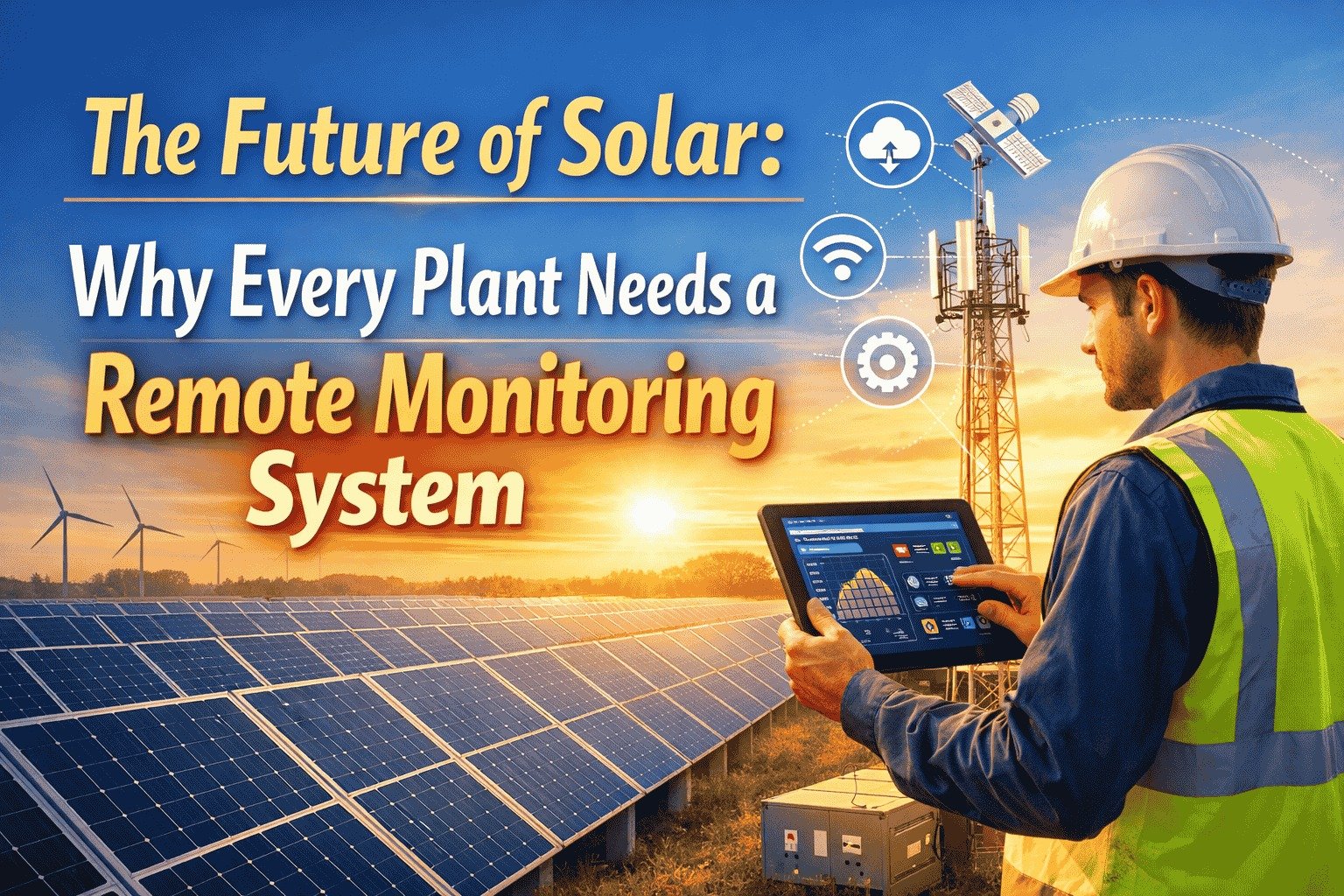
As the solar energy capacity can surge globally, with India targeting around 500 GW of renewable energy for 2030, the industry can face a critical evolution. Installing panels is not just a challenge; maximising the lifetime value is.
Today’s solar plants can operate in increasingly complicated environments, thus distributed across different geographies, integrated with storage systems, and expected to deliver bankable performance data to investors along with regulators.
In the modern landscape, a sophisticated remote monitoring system has transformed from a luxury feature to an operational necessity. Without that, solar assets can become blind investments, generating power that can obscure performance, revenue opportunities, and efficiency losses.
Beyond Basic Metering: What Modern Remote Monitoring Delivers
Solar plant operators who can deploy remote systems solutions experience three fundamental shifts towards operations:
1. From Scheduled to Predictive Maintenance
Instead of the calendar-based service that wastes these resources on healthy equipment or the misses of emerging failures, intelligent monitors can identify the components thus approaching the end of life or towards operating out of optimal parameters. Temperature anomalies for inverters, declining string performance, or the communication failures can trigger the automated work orders, thus reducing downtime for around 40%.
2. Performance Ratio Maximization
The PR, or performance ratio, provides a modern gold standard for the health of a solar plant. A strong remote monitoring system can easily calculate the PR as the expected values through the real-time irradiation data. When the PR drops below a certain threshold, operators can get alerts instantly with the diagnostic insights, thus enabling rapid intervention that can protect revenue along with contractual obligations.
3. Portfolio-Level Intelligence
For those businesses managing different installations, a greatly unified remote system can provide proper control. Compare the performance across multiple locations and identify the best practices from the best-performing sites, and further allocate the maintenance resources based on needs and not on some guesswork. This level of portfolio intelligence can become highly valuable based on solar portfolios at scale.
The Integration Issue: Why Standalone Systems Fall Short
Most of the plant owners generally rely on inverter manufacturer monitoring platforms, a perfect decision that can create significant limitations. These specific tools generally:
-
Monitor of the branded equipment, thus creating major blind spots for multi-vendor installations.
-
No integration or lack of integration with the weather stations, energy storage, or irradiation sensors.
-
Offering limited-level analytics and almost no API access for complete business system integration.
-
Providing minimal historical data retention.
A complete monitoring system like Logics' PowerAMR can solve these problems with their open-level architecture. With the compatibility of these systems across 100+ inverter brands along with strong integration with pyranometers, SCADA systems, and weather stations, this creates a holistic view of plant health.
The API-driven connectivity can further enable the integration with ERP systems, financial reporting tools, and maintenance platforms, thus transforming solar data to transferable intelligence.
The Integration Imperative: Why Standalone Systems Fall Short
The solar plants of tomorrow will operate in different dynamic environments, and grid operators can demand real-time generation forecasting and participation for virtual power plant aggregations. Plants that don’t have this modern system will be excluded from these value-added opportunities:
-
Capturing of high-resolution data (major 1-min intervals or better) that’s required for forecasting algorithms.
-
Providing communication infrastructure towards grid-responsive controls.
-
Enabling of seamless integration with the BMS (Battery Management Systems)
-
Delivery of data granularity that’s required for renewable energy certification verification.
Real-World Impact: The Numbers That Matter
Just consider a 1 MW solar installation for India:
-
With no monitoring: Operators found out about a failed inverter when doing the monthly billing review, thus losing around 18 days of generation.
-
With basic monitoring: Alerts come easily in under 24 hours, thus reducing losses for around ₹60,000.
-
With the Advanced Monitoring System Installed: AI can detect different performance degradation around 72 hours before a failure, triggering preventive maintenance during downtimes, eliminating the revenue loss with the extension in equipment life.
Multiply this scenario across the portfolio, and a major financial impact can be highly transformational. Industry data reveals that plants that rely on the sophisticated remote monitoring system can achieve around 10% to 22% better lifetime energy yield for those minimally monitored counterparts, thus impacting project RRR along with asset valuation.
Choosing the Right Remote Monitoring System: Critical Evaluation Criteria
Not all these modern monitoring systems are created equal. When you evaluate these platforms, do prioritize
-
Hardware Resilience: Industrial-grade data loggers that are rated towards extreme temperatures (from 40°C to +85°C) with multiple and redundant connectivity options.
-
True multi-vendor support: Verified compatibility with the right inverter along with the component brand.
-
Granular data capture: A string-level monitoring system and not just inverter tools.
-
Actionable alerts: Intelligent notifications that help in identification of different root causes & not just some symptom alerts.
-
Local Support Infrastructure: Technical experts and teams who get regional grid codes along with environmental challenges.
How a Remote Monitoring System Improves Solar Plant ROI
A remote monitoring system helps solar plant owners improve efficiency, reduce downtime, and maximize long-term ROI. With real-time monitoring, operators can quickly detect inverter faults, low-performing strings, voltage fluctuations, and generation losses before they impact overall plant performance.
Advanced monitoring systems also support predictive maintenance by identifying early warning signs of equipment failure. This reduces unexpected repair costs, improves plant reliability, and extends equipment lifespan. Features like automated alerts, performance analytics, and centralized dashboards help businesses make faster and smarter operational decisions.
For commercial and utility-scale solar plants, a remote monitoring system plays a critical role in improving performance ratio (PR), increasing energy yield, and reducing operational losses over time.
Why Businesses Choose PowerAMR for Remote Monitoring Systems
PowerAMR provides intelligent remote monitoring systems designed to help businesses monitor, manage, and optimize solar plant performance in real time. The platform supports inverter-level monitoring, automated fault alerts, weather station integration, and centralized dashboard access for better operational visibility.
With multi-vendor compatibility and integration support for SCADA and energy management systems, PowerAMR helps businesses manage solar operations through a single connected platform. Its AI-driven analytics and historical performance insights help operators identify issues early, reduce downtime, and improve energy efficiency.
PowerAMR’s scalable monitoring solutions are built to support commercial, industrial, and utility-scale solar projects with reliable data tracking, performance optimization, and smarter energy management capabilities.
Conclusion: Monitoring Is Not Optional; It’s The Foundation
Beyond the setup stage, the solar industry has grown. The problem of today is to best utilize the technical and economic worth of every kilowatt-hour produced, not to generate electrons. The main nervous system of modern solar facilities is now an advanced remote monitoring system that offers optimization, ensures reliability, and safeguards future investments against rising grid demands.
Those that go above the solar panels to the information, intelligence, and management systems that turn technology into high-performing resources will own the next generation of solar. Your Remote Monitoring System is used as the base for everything that is next, not simply a tool for monitoring.
FAQs
1. What is a remote monitoring system in a solar plant?
A remote monitoring system is a technology platform that helps solar plant operators track real-time performance, energy generation, equipment status, and system health from a centralized dashboard. It helps identify faults quickly, improve operational efficiency, and reduce downtime through continuous monitoring and automated alerts.
2. How does a remote monitoring system improve solar plant efficiency?
A remote monitoring system improves efficiency by detecting performance issues such as inverter faults, low-performing strings, voltage fluctuations, and energy losses in real time. This allows operators to take quick corrective action, reduce downtime, and maintain optimal plant performance for better energy generation.
3. Can remote monitoring systems detect inverter failures?
Yes, advanced remote monitoring systems can detect inverter failures, communication issues, abnormal temperature levels, and performance degradation. Automated alerts help maintenance teams respond faster and prevent extended generation losses that can affect plant revenue and efficiency.
4. Why is real-time monitoring important for solar plants?
Real-time monitoring helps operators continuously track plant performance and quickly identify operational issues before they become major failures. It improves maintenance planning, reduces energy losses, enhances system reliability, and supports better decision-making through live performance data and analytics.
5. Is a remote monitoring system useful for large solar portfolios?
Yes, remote monitoring systems are highly beneficial for businesses managing multiple solar plants. They provide centralized monitoring, portfolio-level performance analysis, automated reporting, and easier maintenance management across different locations through a single platform.
Follow Us
Contact Us