16/05/2026


Blogs
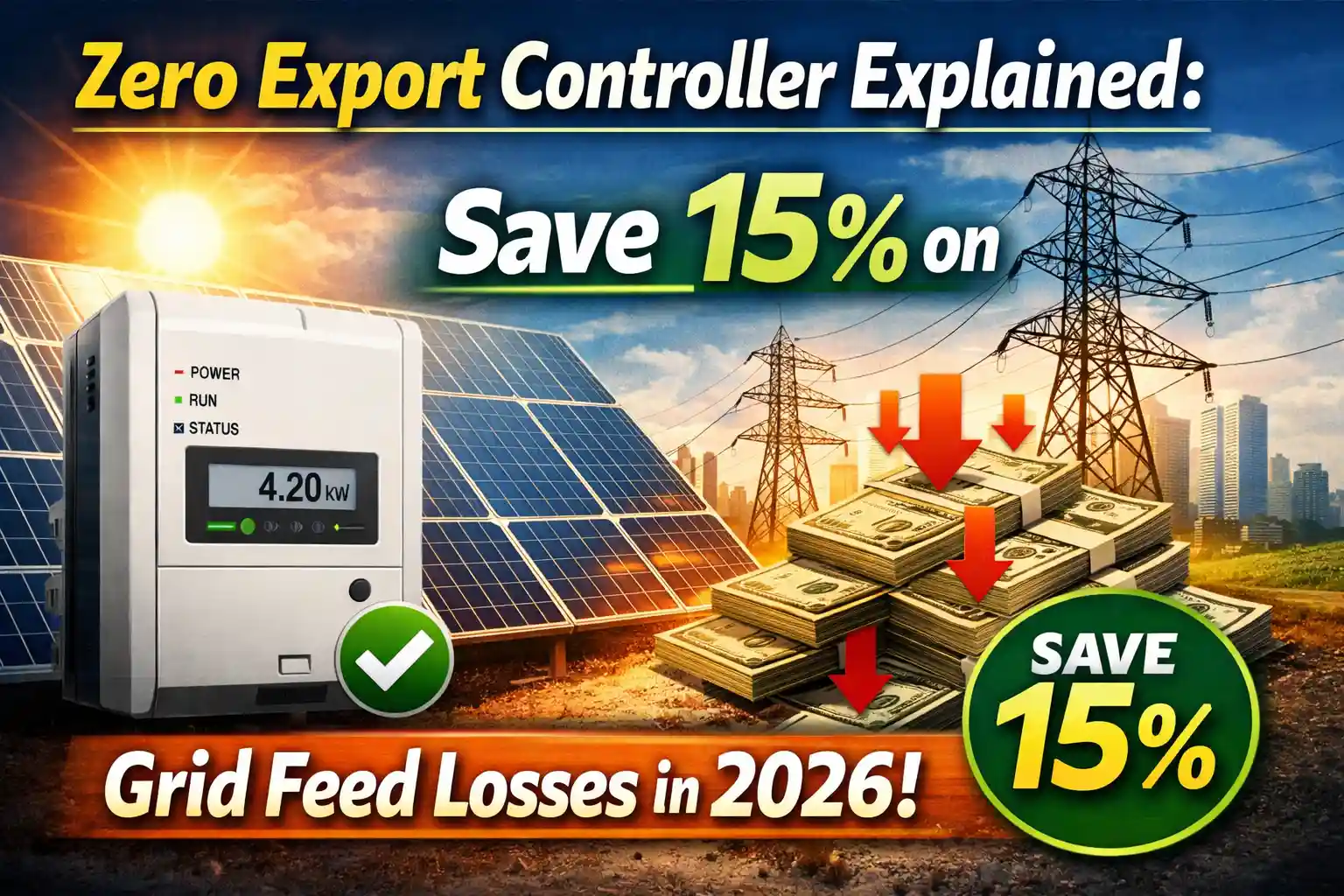
Zero Export Controller Explained: Save 15% on Grid Feed Losses in 2026
Zero Export Controller Explained: Save 15% on Grid Feed Losses in 2026
Solar Power projects are becoming life essential in 2026. Home, offices, public projects, everything is inclining towards using solar power, but there’s a challenge: managing the solar power smartly is important or better, essential.
WHY? Because commercial and residential users lose solar power energy to grid feed losses and penalties due to extra power export. With changing net metering rules and rising grid demand, controlling excess solar energy is necessary.
The Solution? Use a Zero Export Controller.
A Zero Export Controller helps solve this problem in a simple and effective way by managing the flow of electricity. It ensures that only the required power is used on-site and no extra electricity is sent to the grid. Results? Improved system efficiency, less financial losses, and long-term protection for your solar investment.
What is a Zero Export Controller?
A zero export controller is an electronic device that allows us to prevent excess power generated by a solar system from being discharged into the grid. This is helpful for commercial solar installations.
Its main function is to monitor the power consumption of our home or factory. If excess power is generated, it sends a signal to the inverter and reduces output. This prevents the grid from being overloaded. We use it with the help of smart sensors and software.
How Does Zero Export Technology Work?
The working process of Zero Export Technology is simple. You use a smart meter to measure power flow. This enables you to measure electricity consumption in your home or factory in real-time. This boosts solar production.
The meter's information is immediately transmitted to the Zero Export controller. The controller checks whether solar power is generating more than required. It detects excess power.
If excess power is generated, the controller automatically instructs the inverter to reduce output. The inverter then adjusts output so that excess power does not enter the grid.
A real-time adjustment process follows, maintaining system balance. This ensures you always receive the power you need. This does not cause grade feed loss.
Why Grid Feed Losses Matter in 2026?
In 2026, the demand for electricity is increasing rapidly due to industry and urbanization. In such a situation, additional load on the grid increases losses. Additional solar power entering the grid causes a part of the energy to be lost in long distance transmission. This causes you to face financial loss.
Net metering has been limited or controlled in many states for the last few years. You may have to pay a penalty for the excess export. Irregular power flow increases the pressure on transformers and other grid equipment. Maintenance costs may increase.
Key Benefits of Using Zero Export Controller:
A zero export controller impacts electricity bills. This increases system efficiency. By using it, you can also extend the lifespan of your equipment.
Using a zero export controller over the long term provides you with various benefits, including the following-
-
15 percent reduction in grid feed losses:
A zero export controller prevents excess electricity from a home or factory from entering the grid. This reduces transmission losses. This saves costs and improves return on investment.
-
Protection from penalties and overload:
Sending excess power often results in fines. To eliminate this problem, you can use a zero export controller. This keeps your system safe and reduces grid overload.
-
Real-time monitoring and smart control:
A zero export controller monitors power flow and provides accurate data. This enables you to analyse energy usage. It also makes it easier to manage loads based on consumption in your home or factory. Smart control allows you to improve and make your workflow more efficient.
How to Install a Zero Export Controller?
Installing a Zero Export Controller on-site is easy. Follow the following steps-
Step 1: First, inspect the solar system and load pattern. This will help you decide which controller will be suitable for your site.
Step 2: Now, install a smart meter on the main supply line. This allows for mapping power flow.
Step 3: Next, connect the zero export controller to the inverter's communication port, allowing for easy data exchange.
Step 4: After installing the smart meter, configure the settings. This requires setting the load limit and export limit.
Step 5: Now test the system and ensure that no additional electricity enters the grid.
Monitor it carefully for a few days. Once confirmed, consider that your zero export controller is securely installed.
Top Zero Export Controllers for Indian Solar Setups:
-
Power AMR Zero Export Controller:
Designed for precision and reliability, Power AMR's Zero Export Controller offers seamless integration with most of the grid-tied solar power systems, real-time readings, accurate power regulations, and instant response to load fluctuations. Results? It ensures a perfectly smooth operation.
Specification:
-
Input Voltage Range: 230V – 415V AC, Single & Three Phase Compatible
-
Operating Temperature: -10°C to +60°C
-
Response TimeLess than 1 second for real-time control.
Remote monitoring via web/mobile portal, single-line-diagram visualization, and 10-minute performance analytics make it a reliable partner for all industrial and residential solar power system configurations.
2. Elgris Zero Export Controller
Elgris Zero Export Controller is a web-configurable zero export controller. It can control up to 10 separate inverters. It features real-time output adjustment. You can also use USB data logging.
3. SuryaLogix Zero Export Device/Controller
The SuryaLogix Zero Export Device/Controller is a device that allows you to prevent grid feed-in. It can prevent back-feeding and provides grid and solar parameter monitoring support with a built-in data logger.
4. LogX-ZE Zero Export Controller
The LogX-ZE Zero Export Controller is a 4G/Wi-Fi enabled IoT Zero Export Controller. It provides real-time control via a mobile app and web portal. It allows you to monitor multiple inverters/meters from a single device.
5. ePowerControl ZE
ePowerControl ZE provides Grid-Feed-In management. It can easily handle multiple points of injection. It also limits solar production, allowing you to combine power factor resolution and real-time data.
6. TrackSo Zero Export Device
You can use the TrackSo Zero Export Device to prevent power back-feeding to the grid. It provides real-time power control. It allows for multi-inverter monitoring and output adjustment based on net meter readings.
Common Myths about Zero Export Debunked:
-
Myth: Zero export controllers are expensive.
Truth: The price generally depends on the brand and type. It provides long-term benefits and a better return on investment.
-
Myth: Zero export controllers are used for large industrial systems.
Truth: You can also use them for residential and small commercial setups.
-
Myth: This reduces power generation.
Truth: The Zero Export Controller prevents excess power. This does not reduce production.
-
Myth: Installing a zero export controller is extremely difficult.
Truth: You can install a zero export controller with the help of a trained technician. It doesn't require much time or technique.
Conclusion:
In this blog, we have discussed how installing a Zero Export Controller increases your solar power efficiency, protects from fines, reduces the grid feed losses, and offers real-time monitoring and a smart controller. So what to do next? First, find your system requirement and connect with vendors like Power AMR to get A2Z zero export controller devices.
Follow Us
Contact Us