16/05/2026


Blogs
Ambient Temperature Sensors vs Wind Speed Sensors: Which Maximises Solar Output?
Ambient Temperature Sensors vs Wind Speed Sensors: Which Maximises Solar Output?
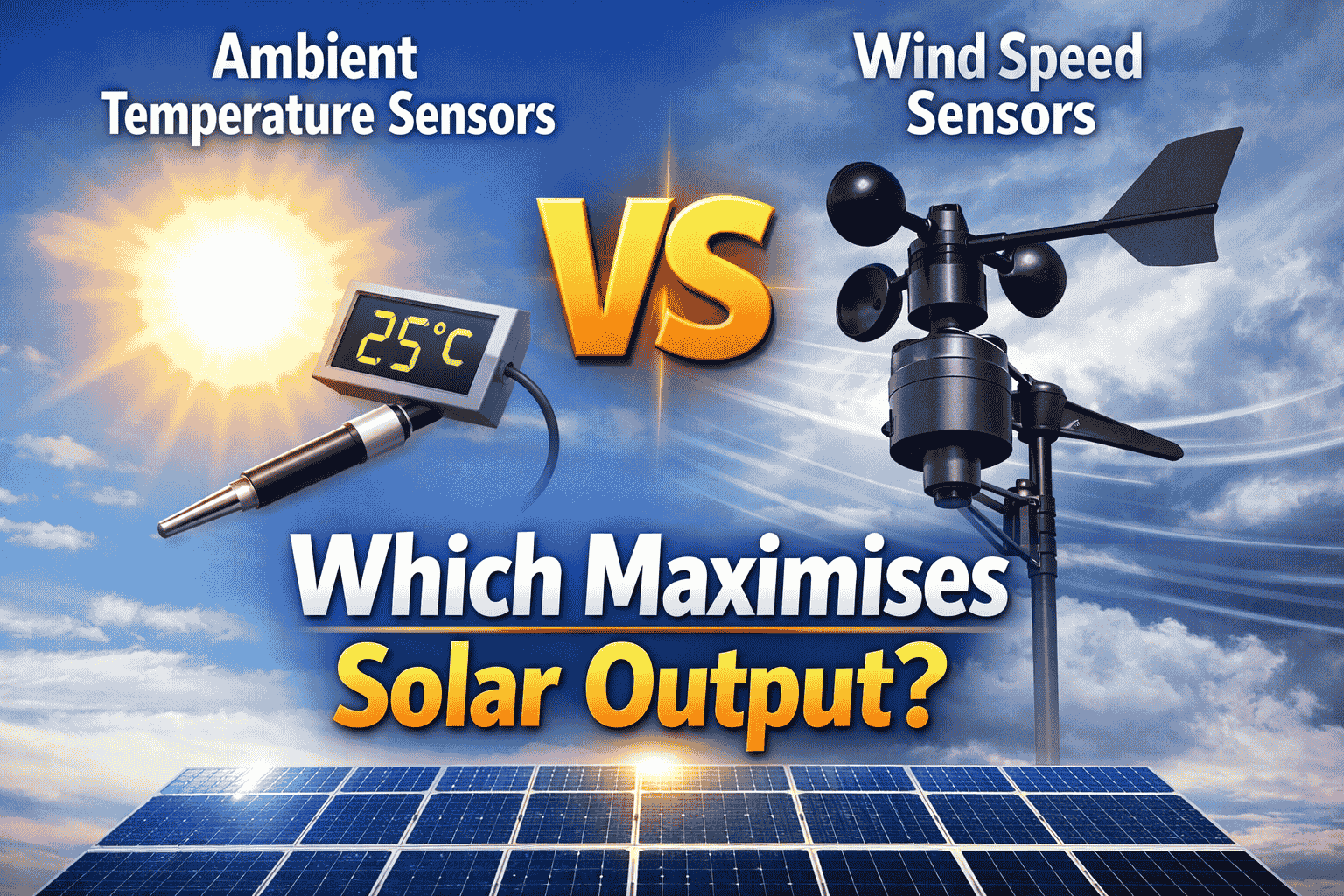
Solar power is growing fast in India and helping homes, farms, and factories cut electricity bills and go green. But heat from our hot sun and changing weather can lower the panel output by up to 20-25% on bad days. This can lower the output efficiency and production or impact the quality of life quality. That’s where Ambient Temperature Sensors and Wind sensors work.
Ambient temperature sensors check the air heat around panels to find the output efficiency drops with early signs. Wind speed sensors track breezes that cool panels naturally and warn of storms. Moreover, they feed data to smart systems to:
-
Adjust panel angles.
-
Clean dust
-
Tweak inverters for maximum power
Now the question is, what to choose among these two? In this blog, we will discuss that.
What Are Ambient Temperature Sensors and How Do They Work?
Ambient temperature sensors measure the air heat around the solar panel and not the panel surface itself. HOW? They use simple tech like thermistors or RTDs (Resistance Temperature Detectors) that change the electrical resistance according to the temperature change.
For example, a thermistor may drop the resistance from 10K ohms at 25°C to 2k ohms at 50°C. This sends a precise signal to the system.
These sensors are placed in shade, under the ventilated shield 1.5-2 meters above ground. WHY? Ideally, they should avoid direct sun error and read the signals every few seconds.
In India’s hot summers, when the temperature sometimes hits 45 °C+, these sensors show the impact of the heat on the panel temps. Results? The system cut the output as silicon cells lose efficiency over 25%. This helps the system predict daily losses and plan cooling.
What Are Wind Speed Sensors and Their Impact on Solar Panels?
Wind speed sensors or anemometers measure the breeze speed (m/s) and sometimes direction too. But there’s more. Modern wind speed sensors use ultrasonic tech and spinning cups. The ultrasound waves bounce between transducers, and the spinning cups rotate faster in stronger winds, and they are linked to magnets that count the rotation. On the other hand, ultrasound-type wind sensors have no moving parts, so there will be no wear in dusty Indian winds.
They are generally placed 3-10 meters high on masts near panels. Why? This position helps them catch the free flow without panel shadow. Cold breezes can easily cool the hot panels by forced convection. For example, a 5 m/s breeze can drop the panel temp by 10-15°C below still air. This boosts the output by 5-8% instantly.
This setting also spots the high gusts over 20 m/s to keep trackers safe and predict the dust storms that can make the panels dirty. For example, high speed winds in Gujarat farms this setting prevents 2-5% yearly losses from overheating or damages.
Key Differences: Ambient Temperature vs Wind Speed Sensors
|
Measurement Focus |
Tracks steady, slow-changing air heat; vital for baseline efficiency models and warranties. |
Captures quick gusts and averages; ideal for dynamic cooling and safety alerts in variable weather. |
|
Cost |
₹2,000–5,000 |
₹8,000–20,000 |
|
Weight & Installation |
Under 200 g; fits anywhere. |
Need sturdy poles against cyclones. |
|
Maintenance |
- |
Calibrate yearly. |
|
Key Data Uses |
Drives PR (Performance Ratio) calculations daily. |
Aids soil forecasts and tracker optimization. |
|
Best Sites |
Works everywhere. |
Shines in sites with >4 m/s average speeds. |
|
Power Use |
Under 1W. |
Under 1W, but needs more wiring height. |
How Ambient Temperature Sensors Boost Solar Output?
High temperature increases the panel heat via conduction, and sensors detect it. Notably, sensors don’t detect the panel temperature but the heat around it. The surrounding heat often increases the panel temperature by 20-30°C above the air temperature in no-wind sun.
Next, the sensors send this live data to the system and adjust the MPPT (Maximum Power Point Tracking) voltages or activate spray cooling.
Results? The system recovers 3-7% of lost kWh.
They integrate with NOAA or NASA models to estimate NOCT (Nominal Operating Cell Temperature) as per the IEC 61724 standards and spot the degradation early. In Rajasthan’s high super-hot days (48°C), this cuts the heat derating from 0.4-0.5% per °C.
Results? This adds 10-15% yearly yields. In case of extreme heat, the sensors alerts the system for cleaning schedules and cooling.
How Wind Speed Sensors Enhance PV Performance?
Cool wind easily removes the boundary layer heat very quickly. This is because the cooling effect scales very fast. Breezes over 1 m/s might increase up to 2%, and 10 m/s may boost the output by up to 15%. The sensors trigger the single-axis tracker to face the wind for maximum airflow or pause in the turbulence over 12 m/s to avoid vibrations.
Next, these sensors predict soiling easily. The low wind builds the dust and causes everyday losses by up to 0.5-1%. Such signals help the system track dusting and automatically initiate the scheduled washes.
Note:
In a combined system, where temperature sensors and wind sensors both operate and compliment together, the system yields 5-12% better forecasts than a temperature sensor alone. This protects the investment by halting ops in gales and cuts the repair costs by 20-30%.
Head-to-Head Comparison: Which Sensor Delivers Better Results?
|
Main Job |
Tracks air heat for efficiency loss prediction |
Measures breeze for cooling, soiling, safety |
|
Effect on Output |
Counters 0.4-0.5% loss per °C over 25°C; 5-10% yearly gain |
2-15% instant cooling boost; 3-8% average in windy sites |
|
Cost |
₹2k-5k; easy plug-in |
₹8k-20k; mast + calibration needed |
|
Install Ease |
Simple, low height |
Tall pole, windproof mount |
|
Best For |
Hot calm areas, all scales |
Windy farms, trackers |
|
ROI Time |
6-12 months |
12-24 months |
How to Choose the Right Sensor for Your Solar Setup?
We have discussed how ambient temperature and wind sensors operate and boost the output. But the question is how to select the right sensor for your solar setup. Here are a few factors to consider:
-
Start with ambient temp for rooftops or basic ground-mounts. This is because heat is responsible for losses up to 90%.
-
Add wind if the wind rose shows a speed of more than 5 m/s averages, or for trackers over 100 kW.
Here are some budget tips for you:
-
Buy integrated stations (₹20k-50k) for both + irradiance
-
Check IP65+ ratings for dust/rain.
-
Test with 1-month logs before full rollout.
Conclusion:
Ambient temperature sensors and wind sensors make the Indian solar power systems stronger and more efficient. How? They sense the heat and wind speed that often reduces the power output. The entire automated system then takes necessary steps to maintain the power output and minimise the losses.
Ambient temperature sensors fight heat losses everywhere in India, while wind sensors unlock cooling and breezy spots. Together, they often deliver 7-15% extra yield and make the solar farms more profitable amid rising tariffs.
So, where to start? Start with temperature sensors for sure wins. Next, survey the site and add wind sensors for enhanced efficiency. Next, track the data for the results.
FAQs:
-
What is the primary role of ambient temperature sensors in solar energy systems?
Ambient Temperature Sensors measure air heat around panels to predict efficiency loss from high temps and adjust systems for better output.
-
How does wind speed affect solar panel efficiency, and why use a sensor for it?
Wind cools the hot panels and boosts the power output by up to 2-15%. The wind sensor tracks the breeze speed and helps calculate the impact. Moreover, wind sensors also help spot the soiling on the panels due to heavy winds.
-
Which sensor is more cost-effective for maximising solar output, ambient temperature or wind speed?
This totally depends on your region and weather conditions. However, ambient temperature sensors are cheaper (₹2k-5k) and give steady gains everywhere. They are especially helpful in Indian weather.
-
Can I use both ambient temperature and wind speed sensors together in a solar farm?
Yes, you can use both ambient temperature sensors and wind speed sensors together in a solar farm. Notably, using them together improves the forecast's accuracy and yield by 7-12%.
-
What are the installation challenges for wind speed sensors on solar setups?
Wind sensors are tough to install as they need tall masts of about 3-10 m, windproof mounts, yearly calibration, and protection from dust or cyclones. This may require an early installation cost, but the future results will be phenomenal.
Follow Us

Contact Us