16/05/2026


Blogs
How to Select the Right Ambient Temperature Sensor for Your Project
How to Select the Right Ambient Temperature Sensor for Your Project
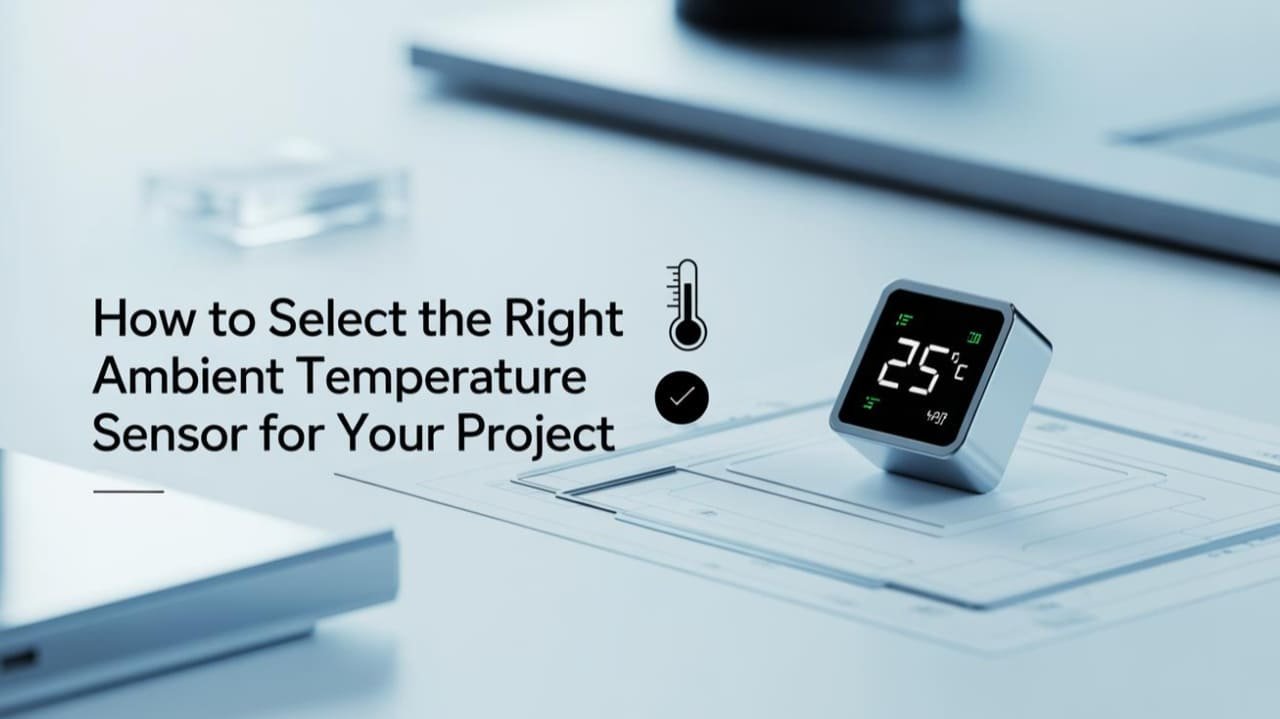
If you’ve ever wondered why some devices run smoothly for years while others struggle, the answer often comes down to how well they handle temperature. An ambient temperature sensor might look like a tiny part of your project, but its impact is huge. It keeps the internal environment in check, helps your components stay healthy, and allows the entire system to react the moment conditions start to shift.
The tricky part is that not all sensors work the same way. Some are designed for quick reactions, others for precision, and a few are built to survive tougher surroundings. Understanding these differences makes it much easier to choose a sensor that matches what your project actually needs.
This guide covers the essentials in a simple, practical way so you can pick the right ambient temperature sensor with confidence and avoid the common mistakes that often show up later.
Understanding Ambient Temperature Sensing: The Basics and Importance
An ambient temperature sensor is a device used to measure the temperature of the surrounding space through electronic sensing. These ambient temperature sensors are used in various devices like IoT devices, HVAC systems, industrial control unit devices, consumer electronics, and medical devices.
To find the actual temperature, ambient temperature sensors help in proper system performance, protect the devices from any type of failure, and improve durability and efficiency of the device while using it. They also prevent overheating and reduce the chances of fire, as well as help in increasing the overall performance of the device.
Key Specifications to Evaluate: Accuracy, Range, and Response Time
For choosing the perfect Ambient Temperature Sensor, you need to check some of its specific criteria:
(1) Accuracy:
Accuracy refers to how accurately the temperature sensor senses the temperature. Because some sensors have ±1°C accuracy and some have ±2°C accuracy. So according to the system performance and device requirement, choose the one which will provide the most accurate result.
(2) Range:
There is also a need to check the range of temperature. Check where it starts sensing the temperature and where it ends. The typical Ambient Temperature Sensor can sense −40°C to +125°C temperature.
3) Response Time:
Response time refers to how much time the sensor takes to sense the temperature. Checking the response time is important because it helps to prevent the loss or damage caused by sudden temperature increases. The faster the response time, the better the device can react to temperature changes.
The response time is mostly checked to measure how quickly the sensor detects the temperature of the surrounding environment.
Output Types: Analog vs. Digital Sensors (I2C, SPI, 1-Wire)
For selecting the temperature sensor, we need to understand the differences and benefits of Analog Temperature Sensors and Digital Sensors.
Analog temperature sensors are the most preferable temperature sensors because they are simple and easy to use. They measure temperature by measuring voltage. They are also easily available at very pocket-friendly cost, and the response time is also very fast.
Digital sensors (I2C, SPI, 1-Wire) have a very complex arrangement with longer cable lengths. They are good for outdoor and long-distance applications. However, they are generally costly and not easily available in every region.
Power Requirements and Operational Environment Considerations
For choosing the right Ambient Temperature Sensor, you also need to understand the power requirement of the sensor. Check whether the sensor consumes high power or low power. Some sensors work in the microamp range and some in the milliamp range.
The power requirement of the sensor also depends on where it will be kept. If it is kept in a high-temperature or humid or dusty region, it will affect the sensor working. So, for longer performance you need to check the working of the sensor in different conditions.
For that, you need to check some of the points like IP rating, conformal coating, and manufacturing quality—how the sensor is manufactured to resist harsh environmental conditions. These points will help you understand the working capability of the sensor.
Physical Form Factor and Installation Factors
Temperature sensors come in various physical designs. It depends on which type and shape of sensor is suitable for your device for proper accuracy.
Temperature sensors come in various shapes like:
-
Probe type
-
Surface-mount (SMT / SMD chip sensors)
-
Flexible film sensors
The choice of the sensor depends on the available space and the actual working conditions.
-
Installation method
-
Enclosure design
-
Cooling requirement
With proper installation as per the space, the airflow within the region will stay stable so that there is no high heat and dust accumulation on the sensor. This will help in the proper working of the sensor.
The proper installment gives accurate readings.
Cost vs. Performance: Balancing Your Project Budget
High ambient temperature sensors give proper performance with high accuracy, but as per their working, their cost increases as performance increases.
If you go for a lower price, then you have to compromise with accuracy and performance, which may lead you to face further losses due to device failure.
In some industries like medical and industrial working areas, there is no compromise with efficiency of the sensor, because even a small compromise can cause high failure.
Therefore, buying a high-quality and reliable sensor can be a one-time investment, which will help to protect your device from long-term damage.
Step-by-Step Selection Guide for Common Applications
For the efficient and safe use of temperature sensors, there is a need to understand the working steps.
Steps:
Step 1: Choose which type of IoT device you want to use.
Step 2: Identify the application in which you need to measure the temperature.
Step 3: Set the temperature range as per the requirement and the presence of the device in a region.
Step 4: Check the temperature reading on the device screen and try to compare it to the surrounding environment to ensure accuracy.
Conclusion: Making Your Final Decision
So, according to the working accuracy and the application, choose the right ambient temperature sensor.
Through proper working, you can protect your device from getting overheated. With the help of the ambient temperature sensor, you can measure the temperature of the device, which helps in the proper functioning of your device for a long time.
A smart sensor choice keeps your system safe, efficient, and future-ready, which is the standard we aim for at Logics PowerAMR.
FAQ
What is the difference between analog and digital ambient temperature sensors?
The difference between analog and digital temperature sensors is that analog sensors sense temperature through the voltage variation, whereas digital sensors through communication show the temperature directly.
How do I determine the required accuracy for my temperature sensor?
If your device requires high precision, it needs ±0.1°C accuracy, and general devices require ±1°C.
What are the main advantages of using an RTD over a thermistor?
RTDs have high accuracy values, stability, and long-term working capability. On the other hand, thermistors are cheaper and give faster response.
Can I use one sensor type for both indoor and outdoor applications?
Yes, you can use sensor type for both indoor and outdoor applications to protect your device from the outside environment.
Follow Us



Contact Us